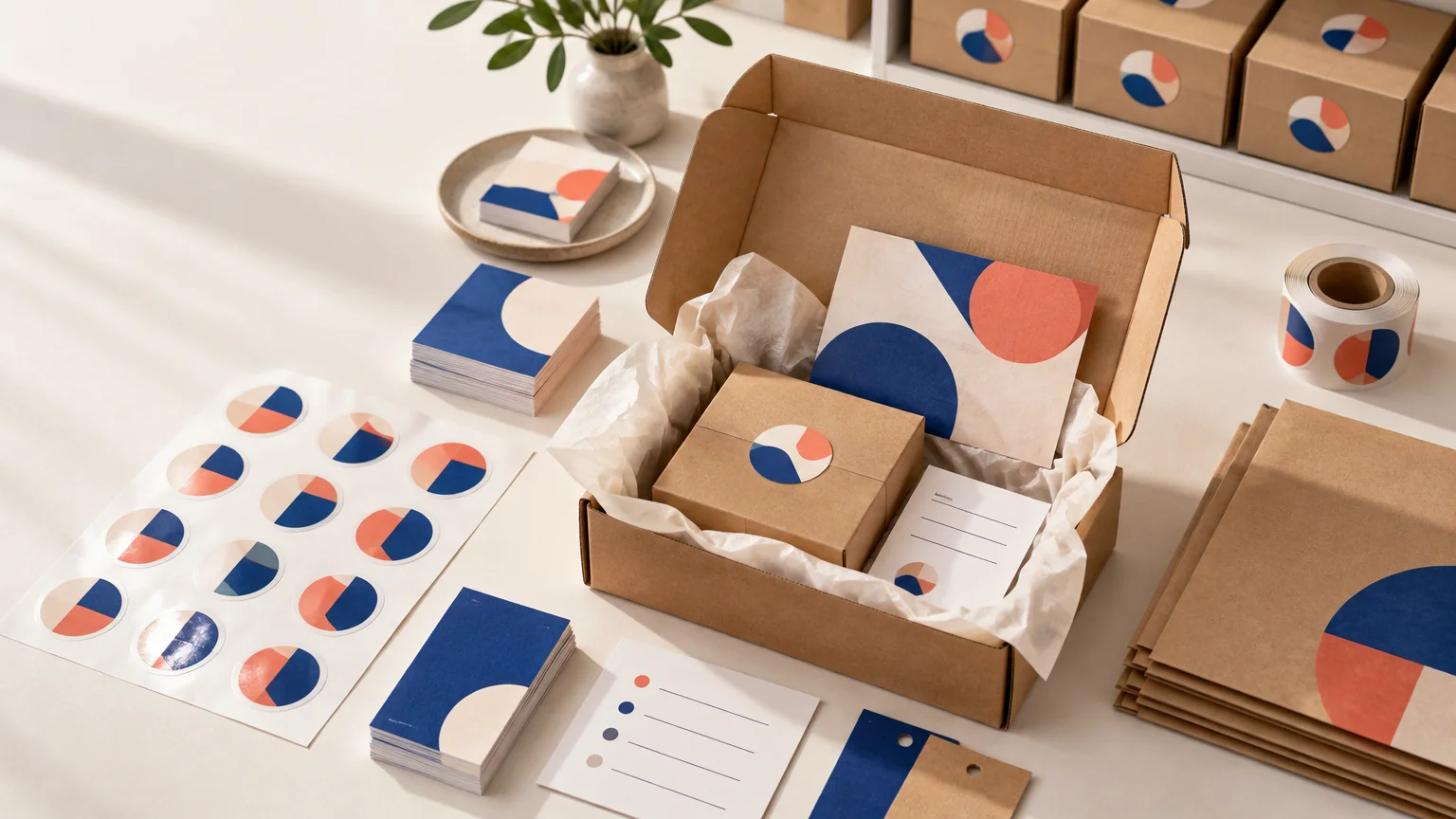
Quick Prints Fulfillment for Small Brands: When Print and Packing Should Become One Workflow
TLDR
A Quick Prints Fulfillment small brand workflow is worth exploring when every order requires the same coordinated set of products, labels, inserts, stickers, and packing steps. Consolidation can reduce handoffs and make version control easier, but it is not automatically cheaper or more accurate. Before moving inventory, ask Quick Prints Fulfillment to document what it prints or sources, how it receives and counts stock, how it controls collateral versions, and how it handles packing errors. Approve one completed sample and run a limited pilot before committing the full operation.
The right time to combine print and fulfillment is not simply when a provider offers both. It is when your package has become a repeatable branded system—and managing that system is consuming time that should be spent on product, marketing, or customer care.
A founder shipping ten highly personalized orders may benefit from keeping the work close. A brand sending hundreds of substantially identical launch kits may gain more from a documented workflow in which approved collateral, inventory, packing instructions, and shipment records live together. The decision turns on repeatability, variation, control, and total operating cost.
What a combined print-and-fulfillment workflow includes
Fulfillment is often discussed as if it begins when an order appears. For a design-conscious brand, the workflow begins much earlier. Artwork has to be approved, printed components must be assigned current versions, incoming quantities need to be reconciled, and the pack-out order must be documented before anyone seals a mailer.
A coordinated workflow usually has these stages:
- Approve the artwork, material, dimensions, finish, proof, and production quantity for each printed component.
- Give every approved label, insert, card, or sticker a clear filename and version identifier.
- Receive products and printed collateral, record quantities, and isolate damaged or obsolete stock.
- Build and approve a representative packed order, sometimes called a golden sample.
- Document the sequence, orientation, placement, and quantity of every pack-in component.
- Release orders for picking, packing, shipping, and inventory deduction.
- Review shortages, errors, returns, promotional changes, and replenishment needs on a defined schedule.
This structure matters because print production itself spans several dependent decisions: product format, material, size, design, proofing, finishing, packing, and shipping. Treating each decision as a disconnected purchase creates more opportunities for old artwork, missing components, or incompatible materials to enter the process.
The tipping point for a small brand
Consolidation becomes attractive when the package is repeatable but no longer simple. Look beyond monthly order volume. Fifty orders containing six carefully coordinated components may create more operational work than 200 orders containing one product and one generic thank-you card.
Strong signals include recurring orders, subscription shipments, bundles, multiple SKU combinations, seasonal insert changes, wholesale sample packs, creator mailers, and launches with a fixed shipping date. Another signal is founder time: if printed pieces arrive at a home or office only to be counted, stored, sorted, and shipped somewhere else, the extra handoffs deserve scrutiny.
A combined workflow is less compelling when nearly every order requires open-ended personalization, when product handling needs exceed a standard warehouse operation, or when order volume is too irregular to justify storage and administration fees. Products involving regulated labeling, hazardous materials, temperature controls, or specialist records also require capabilities that must be verified separately.
Separate vendors versus one coordinated workflow
| Decision factor | Separate print and fulfillment vendors | Coordinated workflow | What to verify |
|---|---|---|---|
| Owner coordination | The brand manages purchase orders, deliveries, artwork revisions, and handoffs. | Fewer parties may need to coordinate routine replenishment. | Identify who owns each task and exception. |
| Storage | Collateral may be stored by the brand, printer, or fulfillment partner. | Products and printed components may be held near the packing station. | Confirm storage rates, limits, stock separation, and disposal rules. |
| Version control | The brand must prevent old and new collateral from mixing during transfers. | One controlled inventory record can simplify changes if the process is documented. | Ask how obsolete versions are quarantined and destroyed or returned. |
| Quality approval | Print proofs and pack-out approval may happen in separate systems. | A completed sample can connect print approval with packing approval. | Require written sign-off points and retained reference samples. |
| Promotional changes | Different vendors can preserve flexibility but add coordination. | Changes may be easier operationally but could affect lead times or minimums. | Document cutoff dates, rush options, and change fees. |
| Cost | Individual unit prices may look competitive while transfers and labor remain hidden. | Consolidation may reduce handling but add storage, receiving, or kitting fees. | Compare the full landed workflow, not one unit price. |
| Provider flexibility | Specialist vendors can be selected for each component. | A narrower supplier set may make routine work simpler. | Check whether outside-supplied collateral is accepted. |
Neither column is a universal winner. The useful comparison is total cost and control per completed order. Include printing, freight between vendors, receiving, storage, assembly, packaging materials, pick-and-pack charges, revision waste, and the internal time used to resolve exceptions.
A Quick Prints Fulfillment small brand decision framework
Quick Prints Fulfillment should be evaluated as an operating partner, not merely as a place to request a print quote. Its current scope needs to be confirmed directly: whether it produces printed components itself, sources them, or accepts customer-supplied stock; whether it stores finished goods; and whether it supports the required kitting, integrations, shipping methods, returns, and inventory reporting.
Begin with one representative order. Put every component on a single sheet: product SKU, product label, insert, sticker, protective material, mailer or box, and shipping label. Add the approved version, quantity per order, placement, orientation, and substitution rules. That document becomes the basis for a useful provider conversation and, eventually, a pack-out standard operating procedure.
Version discipline is especially important for promotions and regulated product information. A filename such as insert-summer-v3.pdf does not reveal whether the file is a draft, proof, or approved production asset. A controlled status and date make that distinction clearer; a practical print-project version naming system can keep proofs and production files separate.
Keep the print specifications tied to the real package
Operational consolidation cannot rescue an unsuitable label or a poorly prepared insert. Label construction should be selected for the actual container, application temperature, service environment, performance needs, compliance requirements, and end-of-life considerations. Avery Dennison identifies factors such as substrate, temperature, exposure, performance, compliance, and recyclability as relevant to adhesive selection. Its adhesive technology guidance is a useful starting point for discussing the application with a label supplier.
That means testing labels on the production package rather than approving them only on a screen. Curved containers, textured papers, flexible pouches, chilled products, oily surfaces, and frequently handled items can place different demands on the face material and adhesive. Use the package-first process in this guide to designing product labels for the actual container before buying a large run.
Choose inserts with equal intention. An uncoated card can feel tactile and allow handwriting, while a coated surface may support sharper photography. Heavier stock can add ceremony to a launch kit but also affects thickness and shipping weight. Ask for the finished size, stock, coating or lamination, folding method, and grain direction when folding quality matters.
Print files also need production-specific checks. Adobe recommends reviewing matters such as missing fonts, low-resolution images, overset text, bleed and margins, and color handling before exporting a print-ready PDF. Final export settings should follow the printer's requirements. Adobe's print-ready PDF guidance provides a useful preflight overview.
Bleed extends artwork beyond the trim edge to reduce the risk of unintended white edges after cutting. Adobe identifies 0.125 inch, or 3 mm, as a typical amount, but this is not a universal specification; use the provider's template and required bleed. Barcodes and QR codes also need suitable size, contrast, quiet space, and testing on the final material rather than assumptions based on the design file.
Illustrative example: a 500-order launch kit
Consider an illustrative launch of 500 orders. Each package contains one product, one applied product label, one two-sided instruction card, and one loose promotional sticker. This is a workflow example, not a Quick Prints Fulfillment case study or performance claim.
- Approve the label and insert against the physical container and finished package dimensions.
- Assign production versions to both printed files and record the promotion's start and end dates.
- Receive 500 products plus an agreed overage of printed pieces, then count and record accepted, damaged, and missing units.
- Assemble one complete package in the intended order: labeled product first, instruction card facing upward, sticker on top, then protective material and closure.
- Photograph and approve that golden sample, including the position and orientation of each component.
- Release a small pilot batch and inspect completed packages before the remaining launch orders ship.
- After launch, compare physical counts with system counts and set reorder points using actual consumption and spoilage.
The value is not that one company necessarily performs every production step. The value is that one approved specification connects the printed pieces to the packing operation. If specialist sticker production remains separate, roll labels or individually cut stickers can be selected according to whether the item will be applied to packaging or included as a loose pack-in; the supplier itself positions those formats for different uses.
For art prints, cards, or other flat pieces, protection can become part of the same documented sequence. A repeatable small print packaging system helps define sleeves, backing boards, inserts, and shipping mailers before a fulfillment pilot begins.
Questions to ask before moving inventory
Request written answers rather than relying on a broad statement that printing or fulfillment is available.
- Which labels, cards, inserts, seals, and packaging components are produced directly, sourced from partners, or accepted from outside suppliers?
- What materials, finishes, minimum quantities, file requirements, proof types, revision rules, and production lead times apply?
- How are inbound cartons counted, inspected, accepted, and reported? Is a carton count or unit count performed?
- Can inventory be viewed by SKU and collateral version, and how often are physical counts reconciled?
- Which receiving, storage, kitting, pick-and-pack, packaging, and account fees apply?
- How are bundle variations, subscription changes, personalized components, and promotional cutoffs handled?
- What prevents an expired insert or discontinued label from entering a current order?
- Can the provider create a written pack-out procedure and hold shipment until a completed first sample is approved?
- What are the order cutoffs, shipping options, return procedures, damage policies, and error-resolution terms?
- Which ecommerce platforms or order systems are supported, and what happens when an integration fails?
Also ask for an itemized quote covering the whole path from inbound receiving to outbound shipment. A low print price can be offset by transfer freight or handling. A higher kitting fee may be reasonable if it replaces substantial internal labor. The comparison only becomes meaningful when every option uses the same order profile and assumptions.
The practical recommendation
Explore Quick Prints Fulfillment when your small brand has a stable, repeatable package with several printed or assembled components and the current handoffs are becoming difficult to manage. Start at https://quickprintsfulfillment.com/ and ask the company to map its confirmed services against one real order rather than an imagined future catalog.
Do not move all inventory immediately. Provide the component list, current artwork versions, expected order mix, special handling rules, and desired reporting. Request a written pack-out plan, an itemized quote, and approval of one completed sample. Then run a limited pilot that includes at least one ordinary order, one variant, and one exception such as a shortage or address change.
After the pilot, review print conformity, component counts, inventory records, packing accuracy, shipment records, communication, and total cost. If the workflow remains clear when something changes—not only when everything goes correctly—consolidation may be ready to support the next stage of the brand.